Result and Reports
Result & DFA KPI
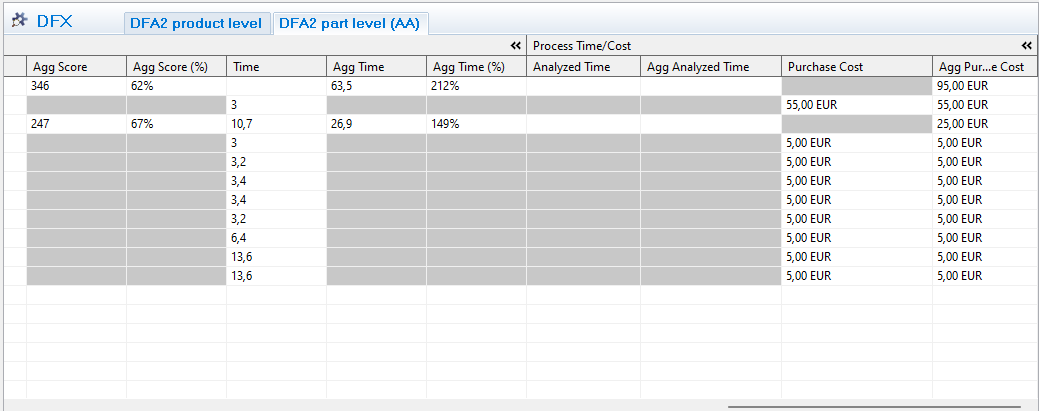
Once the analysis is done, the result and summary can be viewed by scrolling right in the grid.
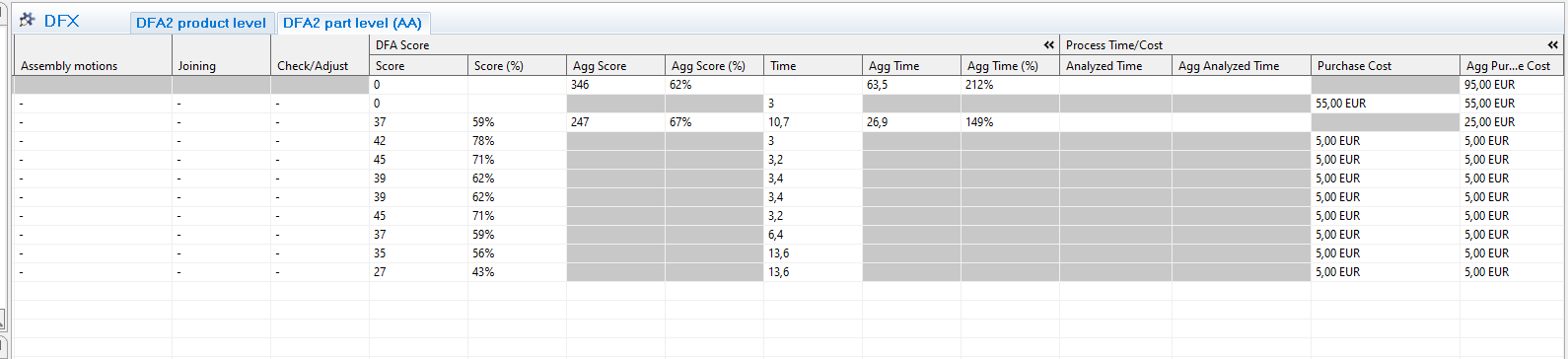
- Score: DFA score that can be compared with the same product in another state of design process
- Score (%): DFA score compared to the total number of score possible.
- Agg score: Aggregated score for all parts.
- Agg score (%): Score divided with total score. Should be at least 70% according to benchmark standards in DFAA
- Time: Optimal time is 3 seconds according to DFAA and are achieved when evaluation is green (score 9).For yellow (score 3) and red (score 1) time is added according to DFAA
- Agg. time: Aggregated time.
- Agg Time (%): How many times longer is required to perform the assembly compared to optimal DFAA index.
(E.g. 500% means 5 times longer than optimal according to DFAA standard)
Reports
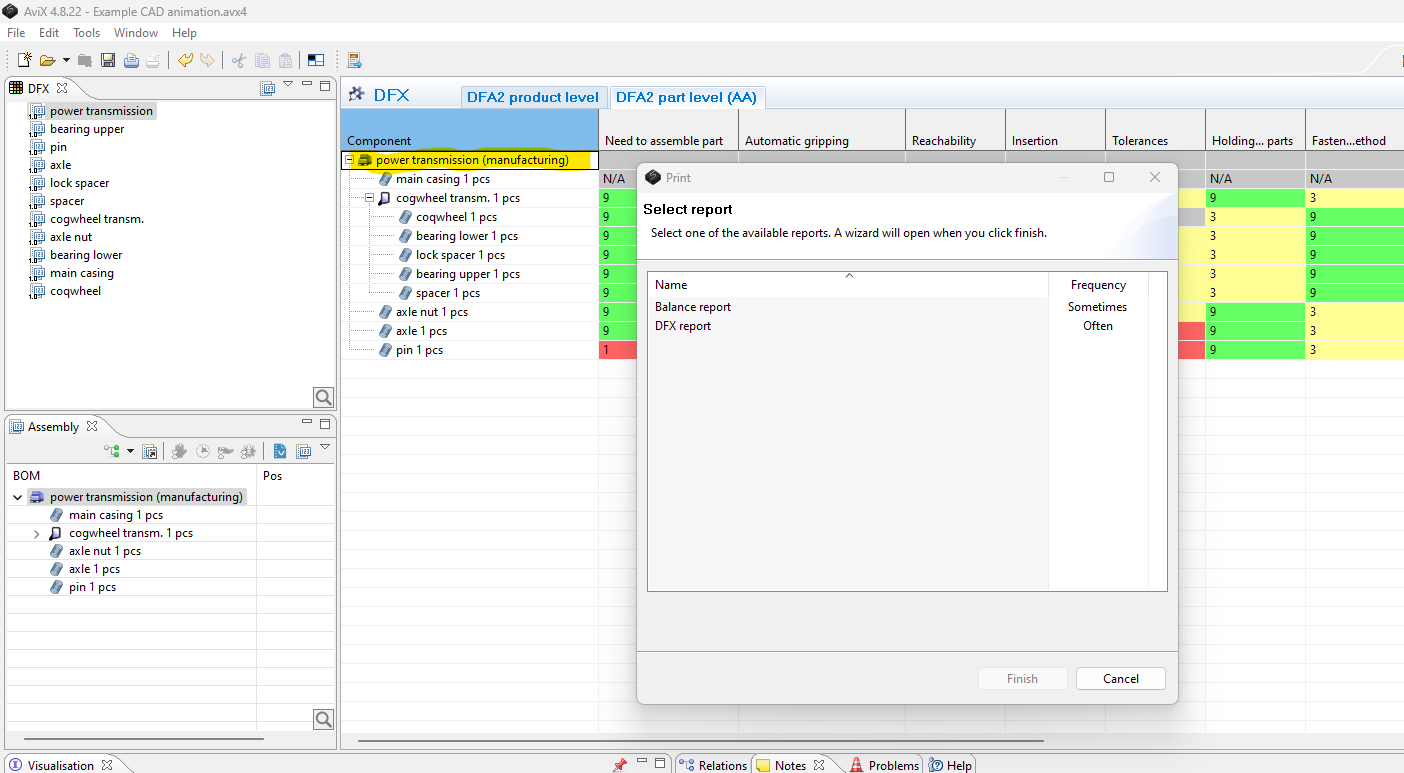
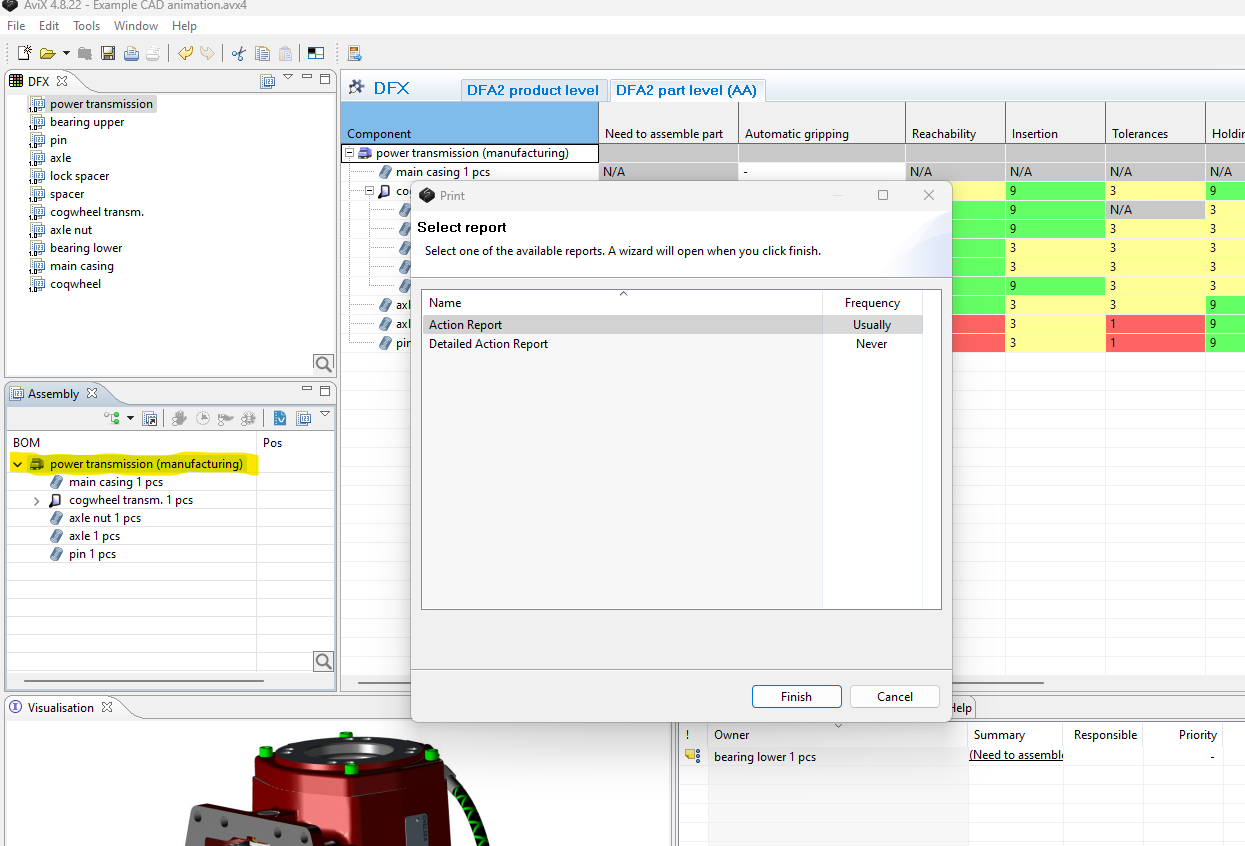
Two reports that can be printed after completing a DFX analysis:
The DFX report, is printed by: Selecting the top assembly level in the DFX grid --> Print button
The Action report, is printed by: Selecting the top assembly level in the Assembly view --> Print button
Re-evaluating & Comparing two designs
After the initial DFX analysis of a certain BOM, different activities within the different disciplines (e.g. purchase, design) might have resulted in a proposed re-design of the product. It is thus a logical step to compare the “DFA index” for the original BOM with the new re-designed one.
Re-evaluating new design
As per methodology
COMPARING DFA SCORES
When comparing two designs it is noticeably that an improved design might have a lower DFA score than the original design. This is because eliminating a part will reduce the total score, making it difficult to compare designs using the DFA-score (Aggregated score) itself.
When comparing two designs, you can:
- Use the %-score (Agg Score %)
- Use the theoretical DFA-time
- Each DFX aspect generates a time based on a theoretical optimal assembly. Thus, comparing two designs where the new design has a lower DFA score it will also have a lower DFA time since it conatins less parts
- Each DFX aspect generates a time based on a theoretical optimal assembly. Thus, comparing two designs where the new design has a lower DFA score it will also have a lower DFA time since it conatins less parts
- Compare the total number of parts.
- Less parts will be a simpler (better) design
- Less parts will be a simpler (better) design