AVIX Resource Balance
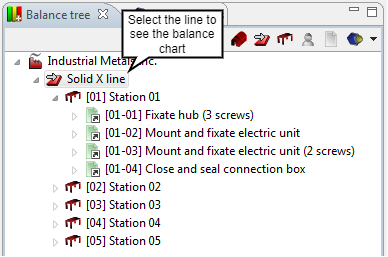
AVIX Resource Balance is a balancing module where all data from AVIX Method are gathered. It is possible to ”build” production lines including all necessary data to be able to balance the work load between workstations.
Open the Balance module by clicking 
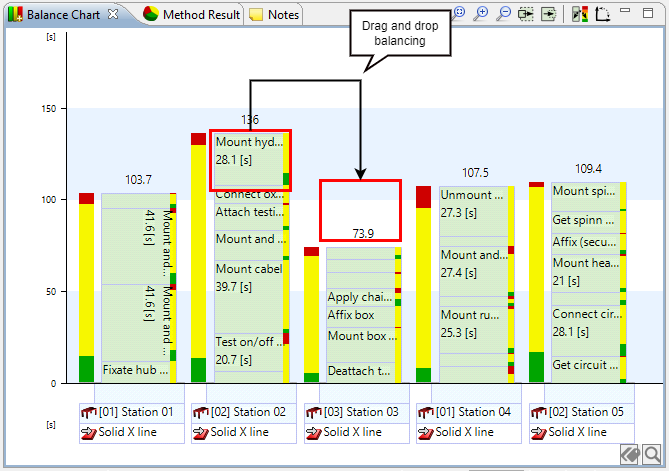
The balance is then performed by “Drag and Drop” (fig.) of the tasks between the workstations.
Balance chart view
Watch video: The balance chart
The Balance graph is a graphical presentation of the line. The bar width can be increased, decreased or tilted to horizontal presentation by pressing either of -buttons 
Multiple lines or variants can be displayed in the balance graph by multi selecting in the Balance tree.
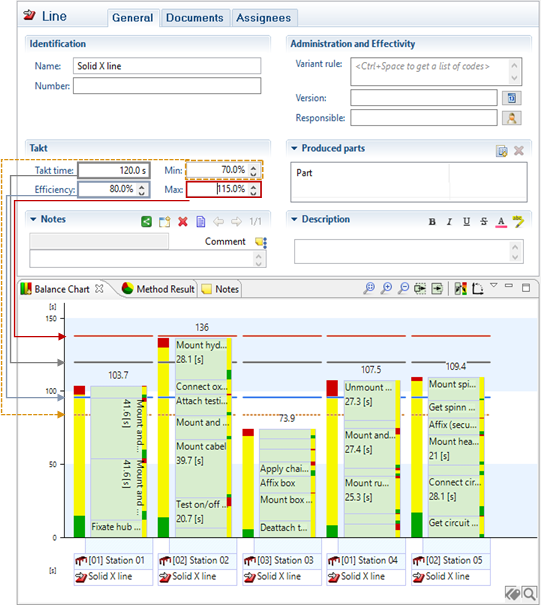
It’s also possible to set the takt time and efficiency rate and also to set the working pace to a higher or lower value when needed (max, min).
Takt time = This is the time it takes to handle/assemble one unit at 100% workload.
Efficiency % = This is the percentage of the speed/workload (unit/takt time) at which work is actually done. This gives a margin to handle unforseen events, eg. having to pick up a dropped tool.
Max % = If the workload generally is low, if agreed upon, one can allow a temporary workload over 100%. This can be achieved by using some of the extra time, available before and after the temporary higher workload.
Min % = This is the minimum allowed workload level.
Multiple resources
Watch video: Set rules
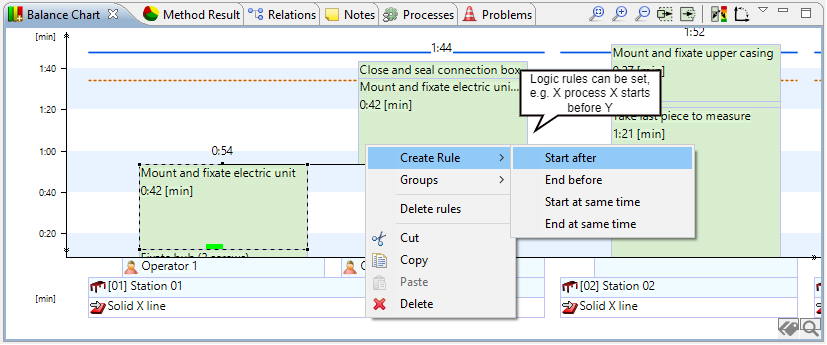
If multiple operators are working simultaneously at the workstation, or when analysing a machine operator (man-machine/GANTT) this can be done using human and machine resources in AVIX .
When working with parallel tasks, rules can be set between tasks in AVIX .Multiple resources will typically have dependencies between then, or require parallel operations. It can be that one operator has to wait for the other operator to finish a process step, or that the operator can do something in parallel with the machine, e.g. load another machine.
The available rules are:
- Start after…
- End before…
- Start at same time…
- End at same time…