Methodology
- Decide whether the DFA is focusing on manual or automatic assembly, different aspect templates can be used in AVIX
- Import MBOM (if only a EBOM is available a MBOM can be built in AVIX)
- The parts in AVIX can carry/contain pictures to be used in the DFA
- 3D models can be used in parallel with AVIX, e.g. Adobe Acrobat Reader
Follow the MBOM
- If a work instruction/decided work sequence is available, follow it
- If not, follow the MBOM starting with the sub-assemblies
- Make the DFA evaluation according to the DFA aspects in AVIX
- Red and yellow (low score). Make a note in AVIX, assign responsible (do not fix the problem during the initial session)
- Try making red parts yellow and yellow parts green by design changes
- Make a copy/paste of the MBOM, then make changes/improvements and a new MBOM (this assures that we have a present/future state to compare in terms of DFA-score
- Compare if it became better/worse
- Remember to compare not only total DFA-score, but also time. If a part is eliminated the total DFA score can go down making the result looking worse. But comparing the theoretical standard times will show a total assembly time reduction.
- Remember also to compare the relationship: Total DFA-score/Theoretical total score = Agg % DFX score when comparing present vs. future state of the design.
The DFA-Regression
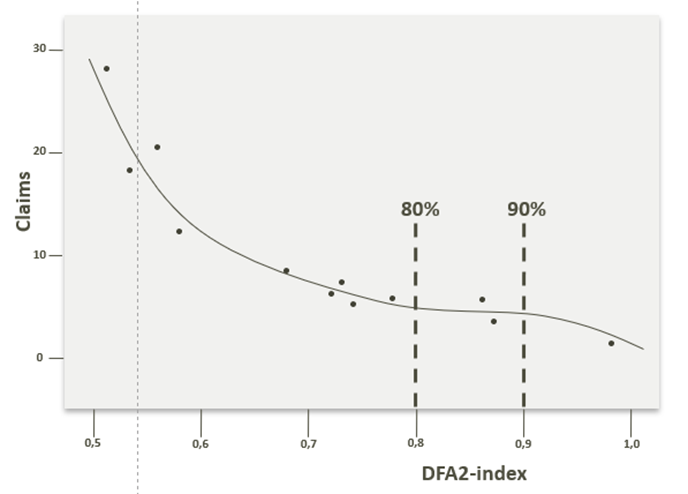
- There is a clear relationship between e.g. number of customer complaints (part errors) vs. the DFA score.
-
- Why? E.g. less parts = less quality issues
- Why? E.g. less parts = less quality issues
-
- This implicates that there is a larger gain increasing the DFA score from e.g. 50-55% rather than from 80-90%
- This should be considered when choosing between different design improvements, maybe the 80-90% is not worth the investment…